
The indispensable party?
Labor's enduring place in Australia's democracy

The Australian Labor Party was founded in 1891. It is Australia’s oldest political party. According to Ben Chifley, Labor prime minister from 1945–1949, Labor has one “great objective—the light on the hill—which we aim to reach by working for the betterment of mankind not only here but anywhere we may give a helping hand. If it were not for that, the Labor movement would not be worth fighting for.” As the party approaches its sesquicentennial, its centrality to Australian governance remains strong. Yet, does the light on the hill still shine, or has it dimmed in old age?
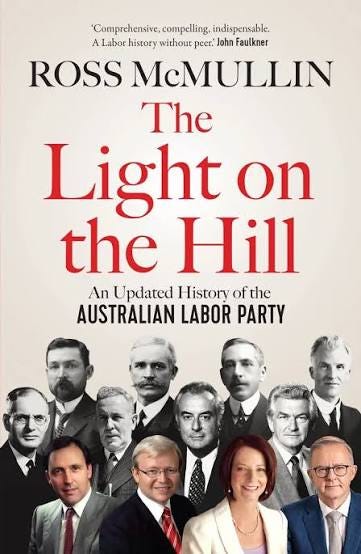
The Light on the Hill, by Ross McMullin, was first commissioned by Labor to celebrate the party’s centenary. Following Labor’s re-election landslide in 2025, the book has been updated and re-released. It includes a new chapter covering events from 1991, when Paul Keating secured Labor a record fifth term in office, to 2024, when Anthony Albanese was precariously holding onto a first-term government. It chronicles 135 years of history over 700 pages. Moreover, though primarily examining federal Labor, this tome also examines the party’s state and territory branches.
This review provides a brief overview of five themes underpinning Labor’s history: origins, party machinations, leadership, political reform, and ideological evolution. For greater clarity, this review will examine only the Federal Parliamentary Labor Party. Following this synopsis, several critiques of the book are examined. It then shifts focus to examine how Labor may have inadvertently aided the current rise of the far right in Australia, while also remaining the primary party to counter this trend in Australia’s political system.
Australia experienced massive economic expansion from the 1850s to the 1890s. Labour scarcity underscored workers’ high bargaining power, which created a strong union culture. As the nineteenth century gave way to the age of capital, the state was increasingly captured by its interests. A global depression in 1890 drastically eroded labour’s bargaining power, and nationwide strikes were crushed by colonial governments. Primarily represented by unions, workers in Australia recognised that parliamentary representation was required to advance their cause. Labor was born.
Socialism underpinned the Australian labour movement. From the outset, however, it was pragmatic, not revolutionary. Australia was a world-leading democracy at the time the labour movement was politically galvanised. Mass migration of the British and Irish working class, a “blank slate” socio-political system, and a limited aristocracy enabled this phenomenon. Though not revolutionary, it was a radical movement that dropped “all pretensions to be statesmanlike [in favour of] continu[ing] to be agitative. Discontent [was] the divine gospel.”
Labor’s rapid political success coincided with Australian federation. With seats in Australia’s inaugural Parliament, Labor representatives declared that they were there for one main purpose: “to make and unmake social conditions.” In these early years, McMullin notes that Labor’s “dynamic presence was the dominant factor in turning yesterday’s heresies into contemporary orthodoxies, whether or not it was Labor governments that eventually introduced them.” The party machinations that helped underpin this success would also contribute to its unravelling.
Union and rank-and-file delegates, with equal representation, determined Labor’s candidates, ministers, and policy at state (annually) and national (triennially) conferences. McMullin states: “As a novel political entity, [Labor] had developed procedures based on ideals of democracy and solidarity so that theoretically all party members had an equal voice in its direction.” Once policy was settled, requiring only a simple majority of votes, politicians were bound by party solidarity. However, Labor’s organisational strength would be undermined by ruinous disagreements.
First, Labor Prime Minister Billy Hughes supported military conscription during World War I to increase Australia’s contribution to the Allied war effort. The federal executive and rank-and-file members fiercely opposed the measure, believing it would disproportionately burden workers. Second, in the 1950s, the perceived influence of communist-affiliated unions, which were defended by Opposition Leader H.V. Evatt, prompted staunchly anti-communist union leaders to split from the party. In both cases, the resulting split consigned Labor to prolonged periods in opposition.
The presence of powerbrokers within the federal executive led to charges that Labor was controlled by “faceless men.” Labor reformed by shifting power away from the federal executive and towards its parliamentary leadership. The national conference remains responsible for determining the party manifesto, but it is dominated by caucus. Moreover, ministers are chosen by the prime minister, although behind-the-scenes factionalism continues to shape the ministry’s composition. Labor today is more of a politician-led party than the grassroots party of old.
A reformist agenda requires inspiring and competent leadership. Federation-era prime ministers Chris Watson and Andrew Fisher instituted reforms that made Australia one of the strongest protectors of workers’ rights. John Curtin gallantly led Australia through WWII. Ben Chifley, Curtin’s treasurer, and then successor as prime minister, led the war economy and ushered Australia into a postwar boom. Bob Hawke and Paul Keating led Australia through one of the greatest periods of economic reform while protecting workers’ rights and advancing First Nations rights.
Other leaders have caused ruin for the party. Alongside Hughes and Evatt, James Scullin, who came to power only weeks before the start of the Great Depression, had, according to McMullin, a “wretched record” in government. His government was paralysed by how to respond, with ideological differences leading to ministerial exits and a collapse of government after only two years. Arthur Calwell, though a competent minister under Curtin and Chifley, was a poor leader in opposition. He lost three consecutive elections and failed to modernise the party for a new era.
Gough Whitlam was an inspiring leader who returned Labor to power after 23 years in opposition. In office, he almost single-handedly modernised Australia’s political institutions. However, his moralistic “crash or crash through” modus operandi contributed to his economic profligacy. Massive public spending coincided with the 1973 oil shock and rising domestic wages to exacerbate stagflation. However, his authorisation to obtain a loan from Middle Eastern brokers fatally damaged Labor’s reputation as economic managers, which hung over them for the next half-century.
Whitlam nonetheless instituted major social reforms, including Medibank and reforms in Aboriginal affairs and women’s rights. These reforms formed part of a broader Labor reform tradition. Watson introduced federal arbitration, Fisher established the age pension, Curtin established the National Welfare Fund, and Chifley introduced the Pharmaceutical Benefits Scheme. Later Labor governments continued this trajectory through Medicare, the Prices and Incomes Accord, Native Title, the National Disability Insurance Scheme, and action on climate change.
That said, these successes have also been accompanied by notable policy failures. The White Australia policy remained a central pillar of Labor policy for almost six decades. Chifley’s attempt to nationalise the banks was ruled unconstitutional and contributed to Labor’s subsequent electoral defeat. More recently, Kevin Rudd’s retreat from climate policy, the political difficulties surrounding the mining tax, and Julia Gillard’s introduction of the Carbon Tax all carried significant political costs. Under Anthony Albanese, the Voice to Parliament referendum was unsuccessful.
Reform, for good or ill, has underpinned Labor’s history since its founding. However, its ideological underpinnings have adapted with the times. The radical labour movement of the nineteenth century, once embedded in Australia’s political institutions and governing during global conflagrations, evolved into a movement centred on state planning and postwar reconstruction. However, with the stagflation of the 1970s, and the neoliberal turn in the United Kingdom and America, Labor adopted a pragmatist stance that prioritised market solutions to social problems, but with strong safety nets.
Labor is currently undergoing another transformation as the neoliberal paradigm is increasingly questioned, with more active government intervention in the market and renewed nationalist fervour, which has been described as progressive patriotism. Nonetheless, whatever iteration, Labor is integral to Australia’s evolving governance. McMullin quotes Albanese:
“our values sit with a majority of Australians, the values of a fair go and not leaving people behind, but also of not holding people back. Those are values of aspiration for a better life. And in order to do that, you have to have a program that takes people with you on the journey of change…”
This review did not reflect McMullin’s chronological method to highlight that this approach, when deployed in books of such length, reads as descriptive rather than analytical. One is left knowing what happened, but not why. By contrast, a thematic analysis, like that adopted by Eric Hobsbawm in his magnum opus on the Long Nineteenth Century, would have been apt. This method provides deeper analytical synthesis by isolating variables and providing a historical thesis for how and why particular events happened when they did, and what their consequences were.
The pitfalls of McMullin’s methodology are apparent in the first chapter, which recounts the formation of labour parties throughout the Australian colonies in the 1890s. Australia is presented as the vanguard of Western labour movements, yet it is not readily clear how or why Australia was in this exalted position. (The brief exposition in this review stems from extraneous research.) Socio-political forces and politico-philosophical paradigms, the critical historical context, are mostly absent from McMullin’s foundational account of Labor.
Although this brief thematic analysis can be discerned from the book, it required substantive notetaking in its margins and a time-consuming review after reading. This leads to a few other critiques of the book. For instance, McMullin was predisposed to naming particular events without giving any context. For instance, in the first chapter, the author mentions that Catholics were waning in their support of Labor in the late 1890s, but it is not explained why. This assertion is counterintuitive given the outsized role Catholics played in the mid-twentieth century.
Another example can be found in chapter three, where McMullin mentions the New Guinea massacre. No explanation of what this was is provided. It turns out, after doing a bit of research, it was a punitive expedition by Australian forces (New Guinea was an Australian territory at the time) following the killing of four white Australians by local tribes. Around thirty Indigenous people were killed in retaliation. Mentions of notable events without explanation are common throughout the book. Once noticed, it was difficult to overlook.
As mentioned in other reviews of mine, a good political biography ought to explicate the historical forces of the time. This book is akin to a political biography, albeit of a party. That said, McMullin’s examination of Labor throughout the ages is largely detached from the broader politico-social events that shaped Australian history. For instance, one learns little of the Menzies Government (and those of his immediate successors) and the Fraser Government, which together total over three decades. A true understanding of Labor’s history is diminished if its greatest adversary remains unexamined.
This problem is compounded by McMullin paying significant attention to changes of cabinet or parliamentary personnel rather than historical events. For instance, nearly three whole pages are devoted to describing the people who comprised the Scullin cabinet after its ascent to government in 1929. By contrast, the start of the Great Depression is only briefly mentioned with the observation that “the New York Stock Exchange spectacularly collapsed” and that “Australia was hit harder than most countries.” The reasons for both are left unexplained. This pattern is exhibited throughout the book.
Such stylistic choices carry into the new final chapter of the 2026 edition. Covering the years from 1991 to 2022, McMullin uses only fifty pages; the previous hundred years required 650 pages, a ratio of 1.3 pages per year in the new chapter compared to 6.5 pages per year in the earlier chapters. This chapter consequently feels half-baked. Curiously, however, the author does provide greater political context, particularly regarding the Howard Government. This is mostly done, however, to explain away the pitfalls of Labor’s leadership and electoral turmoil during this period.
Labor’s raison d’être is to enact pragmatic, social democratic reform. The way this philosophy has been put into practice has evolved over time to meet major political and economic upheavals. The social contract underpinning the current neoliberal paradigm, which emerged in response to stagflation and has dominated Australian policy for nearly fifty years, has fractured. The financialisation and globalisation of the Australian economy are no longer growing the economic pie for everyday Australians. In fact, material conditions are declining. Discontent is rising, and so is the far right.
Australia’s far-right ascendancy is a decade behind America and Europe. One reason for this delay may be the bipartisan decision to ruthlessly close Australia’s “visibly” porous borders to migrants arriving by boat in the 2010s, while retaining “invisible” asylum arrivals via planes and generous, yet orderly, legal migration pathways. Europe and America responded to their migration crises with asylum policies that many voters viewed as disorderly or overly permissive. Support for far-right parties dramatically rose as they were perceived, for a time, as the only parties promising to restore order.
Far-right parties are now key actors in European politics. Trumpism has transformed America, including creating widespread fear among many migrants. Mainstream parties across Europe have belatedly adopted policies similar to Australia’s to minimise support for the far right. Had a pre-emptive Australian approach been implemented, Nigel Farage, Marine Le Pen, Alice Weidel, and others might still be leaders of fringe, rather than mainstream, movements. Instead, they are household names across the Western world and embody politics that threaten liberal democracy.
Australia’s tough-on-asylum policies did not quell all anti-migrant sentiment. The influence of Trump and Brexit, ISIS terrorist attacks in the Western world, combined with a double dissolution federal election, enabled the return of One Nation as a major political force in 2016. Anti-Muslim sentiment was central to its campaign, but it was not the principal concern of most Australians, who generally favoured aspirational policies for Australian families while economic growth recovered post-GFC. Migration was generally viewed positively while economic conditions remained reasonable.
Australia had, and continues to have, high rates of migration. Yet, it is only in the past 12 months or so that One Nation’s polling has skyrocketed. This is due to a confluence of factors. Material conditions for average Australians modestly improved post-GFC but have precipitously declined post-COVID. This has been driven by the highest inflation Australia has experienced in a generation. In particular, housing has become increasingly unaffordable for many. Since 2020, average rent in Australia has increased by 43 per cent and house prices have increased by 53 per cent.
Australia’s recent material decline has coincided with unprecedentedly high net migration, which, between 2022 and 2025, totalled 1.5 million. These are extraordinary numbers. However, they require some context. This rise primarily reflects new visa arrivals post-COVID that were not offset by similar departures during the same period, alongside strong employer demand arising from skills shortages. In 2023, net migration peaked at 568,000 but has since decreased to around 300,000 per year. However, these are still historically high numbers compared to pre-COVID.
Australia’s cost of living has increased alongside a surge in migration, but migration is not the primary cause. Post-COVID inflation has been driven by massive fiscal spending during the pandemic, global supply shocks—first, the Ukraine War and now the US-Iran War—combined with poor productivity growth and wage stagnation. These are significant structural issues that are highly complex. High migration is not a cause of these pressures, but it does exacerbate them, particularly in housing and infrastructure, making it a highly visible and politically convenient target.
Though migration is a contributing factor, blaming migrants who followed Australia’s laws is unfair. Migration has been an important contributor to Australian prosperity since before Federation and will continue to play a pivotal role in Australia’s future prosperity. Moreover, migration has generally made Australia a more representative liberal democracy. Provided migrants embrace Australia’s liberal-democratic values, obey its laws, and contribute to society, there is no justification for holding them responsible for policy decisions made by successive governments.
During tough times, citizens feel the social contract is eroding and seek a scapegoat. Because systemic problems are complex, anti-migrant sentiment rises as a highly visible, simple explanation. Immigrants are then perceived as usurpers of that contract. This creates a political choice: governments can confront these structural problems, or populists can manipulate them. By using emotional arguments that foment fear and resentment, populists offer a false sense of control by promising that, if migration stops, everything else will improve.
One Nation is a nativist party that has consistently polled between 5 and 10 per cent of the primary vote for close to a decade. Its best-known policy is drastically reducing migration, particularly from non-white ethnicities. One Nation has effectively linked the post-COVID boom in migration to the material decline that Australia has experienced in the last few years. Though migration is a secondary contributor to current economic pressures, One Nation was perceived by many as the only party willing to openly acknowledge this connection.
Support for One Nation has also risen because the Coalition is currently unfit to govern. Alongside party-leader bickering, its policies generally advocate for an electorally untenable economic status quo or a One Nation-lite social policy. By contrast, One Nation promises economic and socio-cultural transformation. This helps explain why One Nation, rather than other opposition parties, has occupied the political space vacated by the Coalition. Culture wars are a central pillar of contemporary Australian politics, and One Nation excels at them.
Pauline Hanson recently indicated that the abolition of the White Australia Policy was where it all started to go wrong for Australia. White identitarianism is a central pillar of One Nation’s platform—anti-migrant and anti-Aboriginal remarks were the reason Hanson was disendorsed by the Liberal Party in 1996, and the reason for her notoriety today. However, over the past decade, left-wing identity politics has played a prominent role in political discourse. It was predictable that a dormant right-wing identitarian politics in Australia would recoalesce behind Hanson in response.
This phenomenon helps explain why the Greens have not filled the void of discontent. Many Australians perceive them as espousing a far-left form of identity politics that places disproportionate emphasis on race and gender. The Greens’ identitarian moralism is also perceived by many as off-putting, including by some migrants. Alongside the establishment’s general embrace of this brand of politics and the rise of “cancel culture” more broadly, this has likely contributed to growing support for “anti-woke” politicians in Australia—à la Hanson.
The Greens also favour making migration to Australia easier and do not support capping migration. When most Australians think that current migration rates are worsening the cost-of-living crisis, and people leaning conservative are generally more sceptical of high migration and “big government”, the Greens are misguided to think they can capitalise on material discontent without changing other aspects of their platform. Thus, if neither the Coalition’s nor the Greens’ policies are viewed favourably by the public, attention must return to Labor.
Labor’s policy incrementalism is increasingly considered insufficient to counter the structural problems facing the nation. This approach responded to the public repudiation of its strong reform agenda at the 2019 election and, more recently, to Labor having a majority of one in the 2022–25 parliament. In this parliament, however, Labor appears to be returning to an ambitious reform agenda. That said, according to Anthony Albanese, recent taxation reforms to housing were partly in response to One Nation’s rise.
The rise of One Nation at this moment is therefore the result of several forces coming together: declining material conditions, weak productivity growth, high rates of migration, dormant anti-migrant sentiment, right-wing identity politics, and a growing consensus that the current economic settlement is not delivering for average Australians. Although migration is not the principal cause of Australia’s current challenges, Hanson and her coterie have successfully deployed it as a simple heuristic through which many Australians now interpret them.
Labor remains the primary bulwark against the rise of right-wing populism. Yet it may not succeed unless it realises the raison d’être of its existence: pragmatic reform to enable better and fairer lives for Australian workers and their families. Since Federation, parliamentary politics has effectively been Labor versus non-Labor parties. The “Fusion” of the Protectionists and Free Traders gave way to the United Australia Party, which in turn gave way to the Coalition, which is now giving way to One Nation. Labor has persisted throughout.
Australia is moving into a new era in which neoliberalism’s grasp is waning and international norms are eroding. This is the moment, like Chifley post-war and Hawke and Keating post-stagflation, for Labor to make its mark on the country and determine events, rather than merely react to them. An opportunity was squandered post-GFC through bitter infighting. With a commanding parliamentary majority and a fractured right, Labor may remain in government for some time. It should make the hard, yet practical, decisions that will improve Australia in the long run.
If Labor wishes to retain the political space necessary to pursue deeper structural reform, it must first neutralise the issue around which populist dissatisfaction is currently coalescing. In the short term, this requires reducing migration and communicating that policy shift clearly and consistently to the public. Labor has already begun spending political capital on difficult housing reforms, but more ambitious economic reform will be necessary. That task will become considerably harder if migration remains elevated enough to serve as the focal point for populist discontent.
Labor has evolved hugely from the 1960s. Calwell to Whitlam to Hawke-Keating was a transformation which helped modernise a party that otherwise might have become irrelevant. In government Labor have struggled to get back to what many would deem its party values. Rudd was disappointing, largely because he ran a very conservative agenda, delivering little for the worker. Gillard did remarkably well given minority government, but the media were relentless. Albanese has lost his ticker since the referendum loss. Labor core issues are rarely at the front of debate and policy making (health and education are just not areas Labor seem to be engaging with). Marles, reportedly very bright, is symbolic of where the party is at — desperately trying to appeal to a conservative agenda.
ON are causing problems for both major parties. I’d caution both to find their identity rather than react. The worker’s party must be that if it is to survive. What that looks like in the future will require deep thought. A Labor conference with little to no debate might seem appealing for political purposes, but i suspect it makes them look out of touch and unwilling to hear from rank and file members. In a period of time where democracy is under pressure to deliver, this is hardly helpful. Should Labor wake up and listen to the community, it can easily recover. Does it want to though?
This might be your best article so far. Very readable and informative.
I’ve only ever dipped into the McMullin book (and that was in its first edition only) because whenever I did dip into it, I found it disappointing. And I know why.
McMullin seemed afflicted with a clear aversion to adequately assessing _overseas_ factors, however important those were in the ALP’s history. (Blainey’s books on Australian life never make that mistake.)
You've mentioned McMullin's rather flip reference to the New York Stock Exchange in connection with the Scullin government. Yet the results of Wall Street's crash haunted that government every day of its life, a life itself shortened and eventually ended by the Great Depression.
Even if Scullin had possessed the combined political genius of Metternich and Disraeli, Depression-generated unemployment levels eventually destroyed every Western administration except Italy's. Nobody would guess that fact from reading McMullin's book, though.
Again: take the Split. In the late 1940s and early 1950s, Stalin and Mao seemed unstoppable. The Korean War seemed, after 1951, unwinnable.
In Rome and Paris, communists came very close to achieving power _legally_, as they had done in Eastern Europe. They were doing their damnedest to win over Malaya.
But nine out of 10 readers of McMullin would conclude that the Split was merely about a bunch of cranky Catholics doing their block with Evatt because he wouldn't give them three acres and a cow. Never mind that socialist parties in Italy, Japan, West Germany, and the UK were having similar internal fights on similar issues, at the very same period.
The most recent example: Whitlam and the 1970s' economic crises. Had foreign news been as accessible to Australians in 1974 as it is 52 years on, Whitlam would have fared much better in the public estimation. Because he was facing exactly the same inflationary threats that Wilson faced in Britain, Giscard faced in France, and Schmidt faced in West Germany. Not to mention Nixon and Ford in the USA.
So what does McMullin give us? Basically, little more than Michelle-Grattan-speak about Cairns, Connor, Hayden, and Who Was Up Who on the federal executive. You would scarcely suppose from McMullin that some Australians know about foreign countries.
Anyhow, enough bellyaching on my part here. I enjoyed reading your essay, as I said at the start.